
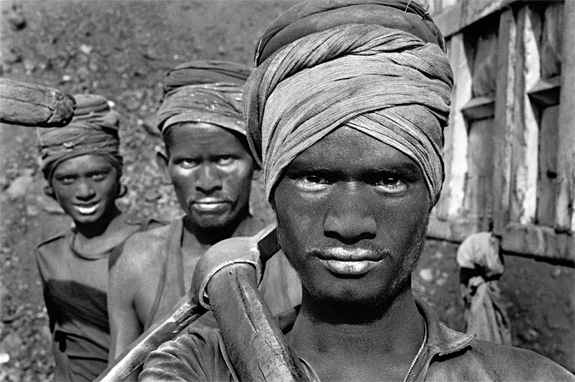


UNICEF Special Representative Sebastião Salgado
Brazilian photographer Sebastião Salgado is one of the most respected photojournalists working today. Appointed
 a UNICEF Special Representative on 3 April 2001, he has dedicated himself to chronicling the lives of the world’s dispossessed, a work that has filled ten books and many exhibitions and for which he has won numerous awards in Europe and in the Americas.
“I hope that the person who visits my exhibitions, and the person who comes out, are not quite the same,” says Mr. Salgado. “I believe that the average person can help a lot, not by giving material goods but by participating, by being part of the discussion, by being truly concerned about what is going on in the world.”Educated as an economist, Mr. Salgado, 57, began his photography career in 1973. His first book, Other Americas, about the poor in Latin America, was published in 1986. This was followed by Sahel: Man in Distress(also published in 1986), the result of a 15 month long collaboration with Medecins San Frontières covering the drought in northern Africa. From 1986 to 1992 he documented manual labour world-wide, resulting in a book and exhibition called Workers, a monumental undertaking that confirmed his reputation as a photo documentarian of the first order. From 1993 to 1999, he turned his attention to the global phenomenon of mass displacement of people, resulting in the internationally acclaimed booksMigrations and The Children published in 2000.In the introduction to Migrations, he wrote, “More than ever, I feel that the human race is one. There are differences of colour, language, culture and opportunities, but people’s feelings and reactions are alike. People flee wars to escape death, they migrate to improve their fortunes, they build new lives in foreign lands, they adapt to extreme hardship….”Working entirely in a black-and-white format, Mr. Salgado’s respect for his subjects and his determination to draw out the larger meaning of what is happening to them, has created an imagery that testifies to the fundamental dignity of all humanity while simultaneously protesting its violation by war, poverty and other injustices.Over the years Mr. Salgado has collaborated generously with international humanitarian organizations including UNICEF, the Office of the United Nations High Commissioner on Refugees (UNHCR), the World Health Organization (WHO), Medecins Sans Frontières and Amnesty International. With his wife, Lélia Wanick Salgado, he is presently supporting a reforestation and community revitalization project in the Brazilian state of Minas Gerais. In September 2000, supported by the United Nations and UNICEF, Mr. Salgado exhibited 90 portraits of displaced children taken from his book The Children exhibited at UN Headquarters in New York. These stunning photographs bear solemn witness to the 30 million people throughout the world, mostly children and women, who are without a permanent home. In other collaborations with UNICEF, Mr. Salgado has donated reproduction rights to several of his photographs to support the Global Movement for Children and to illustrate a book by Mozambique’s Graça Machel, updating her 1996 report as United Nations Special Representative on the Impact of Armed Conflict on Children. Presently, in a joint project with the Global Polio Eradication Initiative, he is documenting the global campaign to eradicate this disease.
Mr. Salgado lives in Paris, France, with his family. His wife, Lélia Wanick Salgado, directs their company, Amazonas Images, and has designed his major books and exhibitions.


 The PasseNger Times art
Scrivi una risposta a Nicoletta Lolli Cancella risposta